
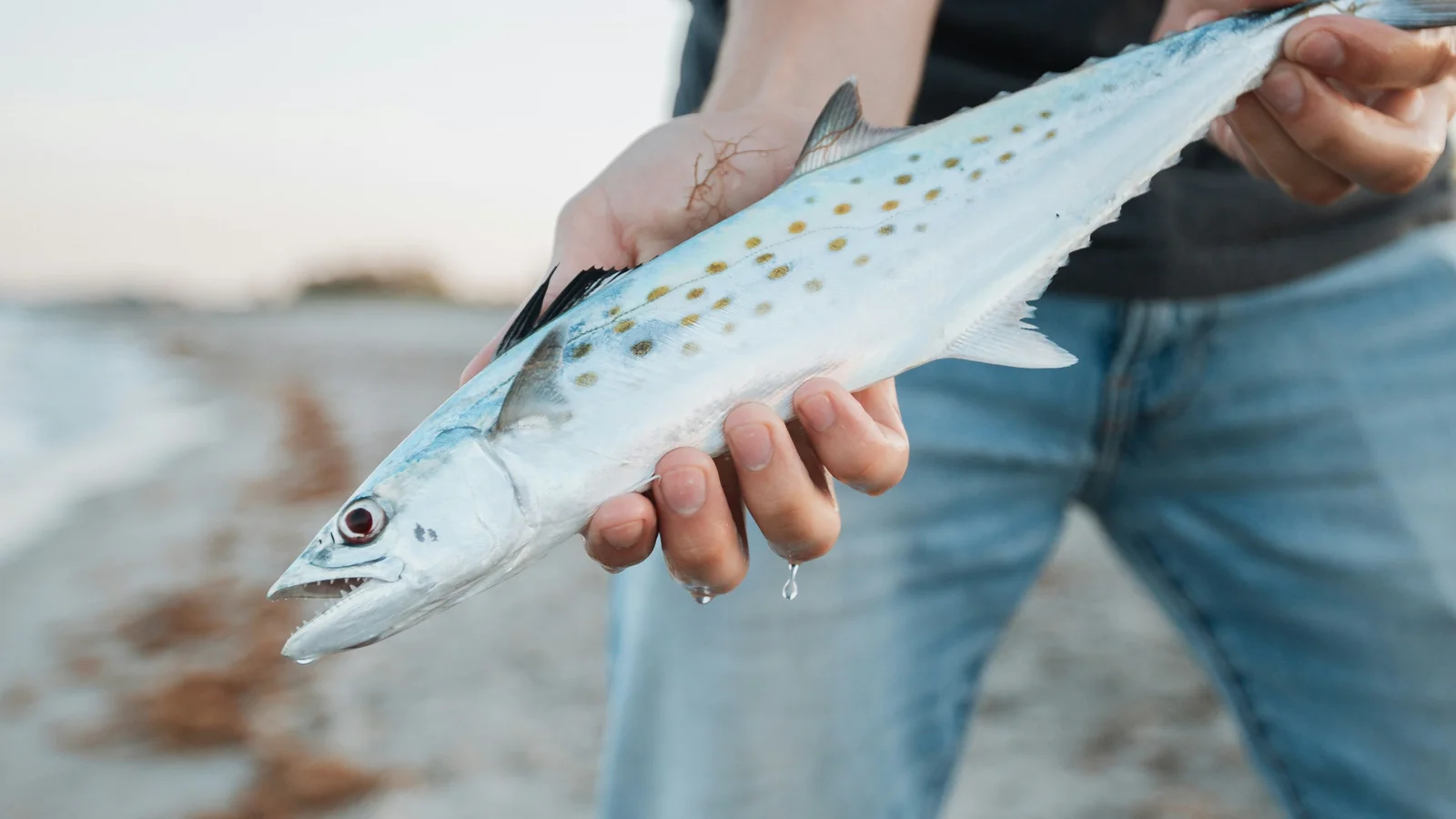
For recreational sea fishing in mainland Portugal, a licence is only the start: your catch must also meet weight limits, minimum sizes and species restrictions. These are the general rules; local restrictions and closed seasons can be stricter. Madeira, the Azores and freshwater fishing have separate rules.
Checked against official guidance on 1 Oct 2026
Daily catch limit
- Shore and boat fishing: 10 kg per person per day, excluding your single heaviest specimen.
- Spearfishing: 15 kg, excluding the heaviest specimen. A shared support boat does not multiply this limit.
- Recreational boats with more than three anglers: 25 kg in total, excluding one heaviest specimen per angler. This boat cap does not apply to spearfishing or licensed tourist-fishing boats.
For example, one shore angler can keep a 4 kg fish plus up to 10 kg of other legal catches. Stop fishing once you reach the applicable limit. Shellfish have separate caps within the overall allowance; see DGRM’s daily catch rules.
Full fish size list
Identify the exact species before keeping it: different sea breams have different minimum sizes. Return undersized catches immediately, even if they are already dead.
DGRM last updated this size table on 26 February 2026. All 48 fish entries are listed below, using its Portuguese and scientific names. This is a commercial size reference also used for recreational minimum sizes; being listed does not mean a species can be kept recreationally. Prohibited species are flagged, and other species may have additional limits or closures. Download the official DGRM table.
| Portuguese / scientific name | Size or weight |
|---|---|
| Areeiros Lepidorhombus spp. | 20 cm |
| Arenque Clupea harengus | 20 cm (a) |
| Atum-rabilho Thunnus thynnus Specially authorised tourist-fishing boats only | 30 kg or 115 cm (b) |
| Azevia, Malacueco Microchirus azevia | 18 cm |
| Badejo Merlangius merlangus | 27 cm |
| Besugo Pagellus acarne | 18 cm |
| Bica Pagellus erythrinus | 15 cm |
| Biqueirão Engraulis encrasicolus | 12 cm (a) |
| Boga, Boga-do-mar Boops boops | 15 cm |
| Carapau Trachurus spp. | 15 cm (a) (c) (d) |
| Choupa Spondyliosoma cantharus | 23 cm |
| Congro, Safio Conger conger | 58 cm |
| Corvina-legítima Argyrosomus regius | 42 cm |
| Dourada Sparus aurata | 19 cm |
| Enguia Anguilla anguilla Retention prohibited in recreational fishing | 22 cm |
| Espadarte Xiphias gladius | 25 kg or 125 cm (e) |
| Faneca Trisopterus luscus | 17 cm |
| Ferreira Lithognathus mormyrus | 15 cm |
| Goraz Pagellus bogaraveo | 33 cm |
| Juliana, Paloco Pollachius pollachius | 42 cm |
| Lampreia-do-mar Petromyzon marinus Retention prohibited in recreational fishing | 60 cm |
| Língua Dicologlossa cuneata | 15 cm |
| Linguados Solea spp. | 24 cm |
| Maruca Molva molva | 63 cm |
| Pargo-legítimo Pagrus pagrus | 20 cm |
| Pescada-branca Merluccius merluccius | 27 cm |
| Pregado Psetta maxima | 30 cm |
| Raia curva Raja undulata Retention prohibited in recreational fishing | 78–97 cm (f) |
| Raias Raja spp. e Leucoraja spp. | 60 cm |
| Robalo-legítimo Dicentrarchus labrax | 36 cm |
| Rodovalho Scophthalmus rhombus | 30 cm |
| Salema Sarpa salpa | 18 cm |
| Salmão Salmo salar Retention prohibited in recreational fishing | 55 cm |
| Salmonete-legítimo Mullus surmuletus | 18 cm |
| Sarda, Cavala Scomber spp. | 20 cm (a) |
| Sardinha Sardina pilchardus | 11 cm (a) |
| Sargo bicudo Diplodus puntazzo | 22 cm |
| Sargo legítimo Diplodus sargus | 17 cm |
| Sargo mucharra alcorraz Diplodus annularis | 14 cm |
| Sargo mucharra branca Diplodus bellottii | 12 cm |
| Sargo safia Diplodus vulgaris | 17 cm |
| Sargo veado Diplodus cervinus | 27 cm |
| Savelha Alosa fallax Retention prohibited in recreational fishing | 30 cm |
| Sável Alosa alosa Retention prohibited in recreational fishing | 35 cm |
| Solha-legítima Pleuronectes platessa | 27 cm |
| Solha-da-pedra Platichtys flesus | 22 cm |
| Tainhas Mugil spp. | 20 cm |
| Truta-marisca Salmo trutta | 30 cm |
Table footnotes and measurement exceptions (a–f)
The source table includes commercial quota and bycatch exceptions. These do not give recreational anglers general permission to keep undersized or prohibited fish. The recreational release rules above still apply.
- (a) Herring, anchovy, horse mackerel, mackerel and sardine: the commercial table allows up to 10% by live weight of each species below the reference size, with conditions covering retention, landing, transport, storage and sale.
- (b) Bluefin tuna: a commercial accidental-catch allowance covers up to 5% by number of fish weighing 8–30 kg or measuring 75–115 cm fork length, subject to ICCAT and EU rules. Recreational retention requires separate authorisation and rules.
- (c) Horse mackerel: a 12 cm reference applies to 5% of the Spanish and Portuguese quotas in ICES division 8c and subarea 9. Within that allocation, an equivalent 1% of Portugal’s quota can be below 12 cm in artisanal xávega fishing in division 9a; a 1.20 weight-conversion factor applies. The source excludes catches subject to the landing obligation.
- (d) Blue jack mackerel (Trachurus picturatus): the table gives an exception from the minimum size in Portuguese waters around the Azores. This is outside this mainland guide’s scope.
- (e) Swordfish: the source describes a commercial accidental-catch landing allowance of up to 15% by number below the reference weight or length, subject to ICCAT and EU rules. Its footnote prints ‘125 mm’, while the main table says ‘125 cm’; the table value is shown here. This is not a recreational allowance.
- (f) Undulate ray: 78 cm is the minimum and 97 cm the maximum, rather than two alternative minimums. Recreational retention is prohibited.
Which fish must go back
Some species cannot be caught or kept recreationally at any size, including groupers (Epinephelus), European eel, ocean sunfish, undulate ray and several sharks. Release accidental catches immediately. Bluefin tuna requires a specially authorised tourist-fishing boat; an ordinary licence is not enough. Check DGRM’s prohibited-species list rather than assuming a minimum size means a fish is legal to keep.
Pollack has an additional limit of two kept fish per angler per day, and must be released from 1 January to 30 April. See DGRM’s pollack rules. Other species and locations have closed seasons too: check the current closures and rules for your fishing area before your trip.
Marking and reporting your catch
When keeping fish caught from shore or a boat, mark each one by cutting its tail fin before leaving the fishing spot or landing. Follow DGRM’s marking diagrams. Recreational catches cannot be sold.
Since 2026, daily electronic catch reporting is required for European sea bass, bluefin tuna, blue marlin, white marlin and roundscale spearfish, including released catches. Portugal uses the RecFishing app. See DGRM’s RecFishing guidance for registration and reporting instructions.